Obsidience
A graph-native, local-first agent harness and Linux desktop shell.
The graph above is live: the real graph UI, running in your browser on Obsidience's own starter Vault, code graph and commit history. Drag to orbit, hold Ctrl and scroll to zoom, click a node, or switch to Memory and Code. About the demo · Full screen
Obsidience runs an Executive Agent on your own machine and gives it a maintained Markdown wiki instead of a pile of prompts. Every Article is a node in one knowledge graph. Agents, Tasks, Runbooks, Skills and Tools are Articles too, and explicit dependencies, never similarity, decide what an Agent may run. Chat and speech enter the same native Executive loop; specialist Agents curate, research and verify; Hindsight keeps per-Agent memory; and a Hyprland + Quickshell shell puts it all on the desktop as live 3D graphs that show exactly which Articles and memories the Agents were given.
This site is the manual. The README on GitHub is the short landing page.
A development project
Obsidience is a development project, not a universal desktop installer. Its native shell, session, model and device scripts are Linux integration profiles that must be reviewed and configured for the target host. Read Requirements before installing.
What you are looking at
The demo's tour loops through three moments. Thinking: the Executive answers a question about its own voice pipeline; a thin pilot light runs the route and the main beam follows it to each Article in its Thinking Packet, while the Action Trace lists the packet, the Hindsight recall (unfolded into memory cards) and the Tool call. Recall: Hindsight lights exactly the memories it returned on the memory timeline. Code: a coding agent's code-graph lookup lights the matching files and symbols, with a card in the graph labels' style.
The clips below are recorded from the real graph UI on a working installation, with its own graph settings: a real voice turn, its memory recall and a code lookup.
Knowledge graph
A pilot light runs the route and the beam follows it to each Article in the Thinking Packet; the Action Trace follows the turn step by step.
Memory graph
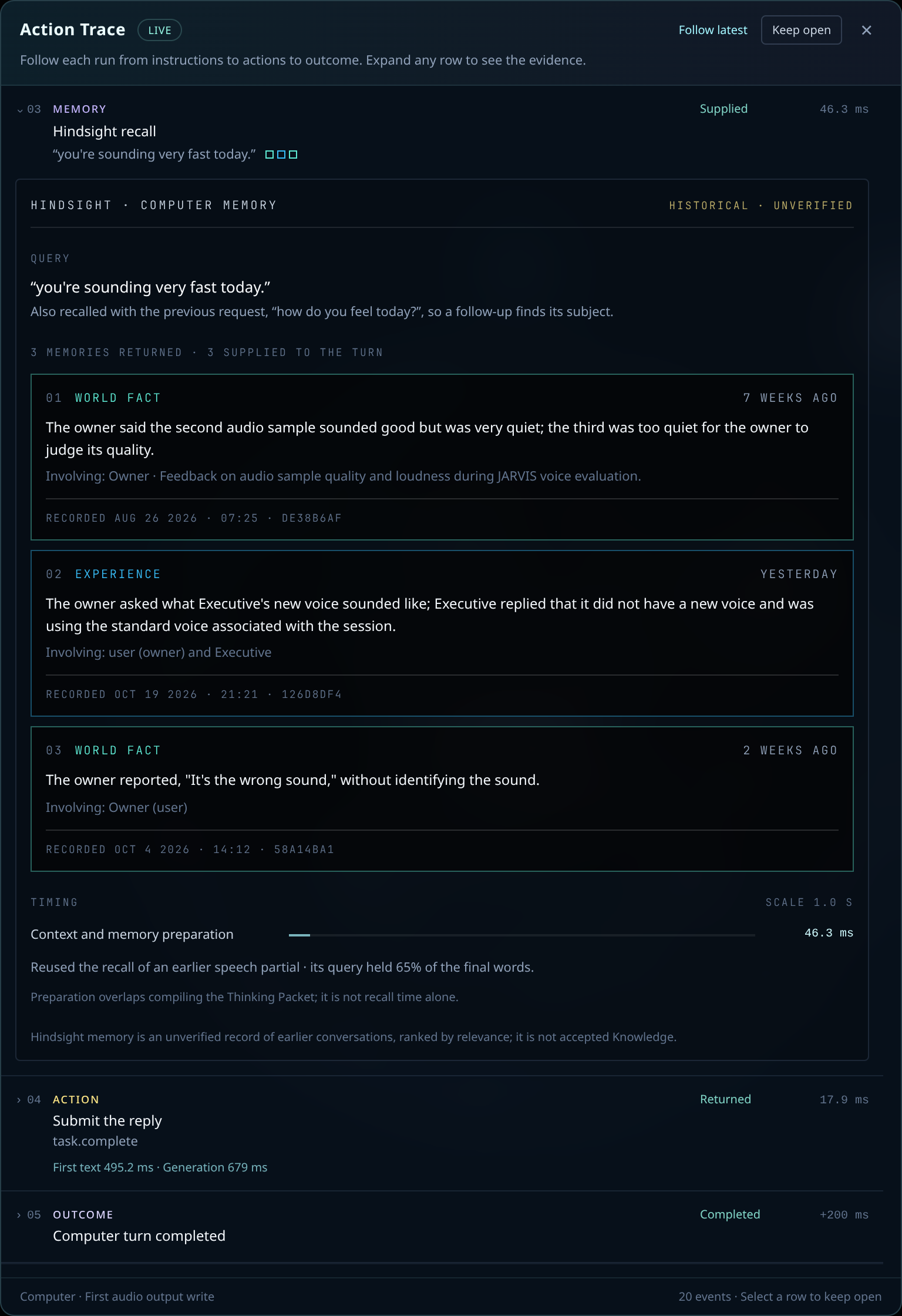
A recall lights exactly the memories the provider returned, and the Action Trace opens into a card per memory with its type, age and recorded date.
Code graph
A coding agent's lookup lights the matched files and symbols, with a card showing the query, the symbols, their paths and the call's duration.
Voice
The Executive explaining its own architecture (52 s, sound on). The graph is the starter Vault with its Architecture route lit, and the central orb follows the speech. The demo uses Pocket TTS's stock alba voice (Alba MacKenna, CC BY 4.0); an installation selects its own voice, which must be one it has the right to use.
Fast voice agents do not wait for silence and then run the whole pipeline from zero; they predict the end of the turn and start early:
microphone (hardware echo cancellation)
  → wake word: CPU spotter, ready chirp within ~0.2 s of "Computer"
  → Nemotron streaming recognition: partials, an early final at the first pause
  → end of turn: Silero VAD + Smart Turn, then the Executive's own verdict,
    speculated at pauses together with its first response and memory recall
  → Executive ADK loop on the local model
  → Pocket TTS, sentence by sentence → speaker (ducks when you talk over it)
See Realtime voice for how the speech path works.
Highlights
- Executive voice and chat. Typed Chat and final speech transcripts enter one Google ADK conversation for the Executive. Its identity Article owns its instructions and its direct Skill catalog; there is no router or preliminary model call.
- A knowledge graph you review. Immutable Sources, an agent-maintained Markdown wiki and its schema are plain files. Agents stage proposals; accepted changes land through Review and a local Git audit trail, then flow into retrieval and the graph.
- Specialist Agents. Darwin researches and hands off cited Sources, Alexandria curates and links Articles, Heimdall checks evidence and performs receipt-safe recovery. They orbit the Executive in the graph.
- Hindsight memory. Optional per-Agent memory banks hold facts, experiences and consolidated observations with original dates, separate from accepted knowledge.
- Code graph. An optional view over codebase-memory-mcp's index of a repository; coding-agent lookups light the exact files and symbols involved.
- A real desktop shell. Hyprland owns composition and input; one Quickshell host serves panes across Surfaces, and a QtWebEngine stage renders the graphs.
- Explicit ownership. Explicit service contracts, declared dependencies, cleanup paired with acquisition and one owner per store, conversation, scheduler and model reservation. Knowledge links never grant a capability.
At a glance
Chat / speech → Executive identity + context → ADK model / Tool loop
Specialist work → Task → Runbook → Skill → Tool
Explicit research / Source intake → immutable Source → Darwin → Inbox → Alexandria
Accepted Article changes → Review / local audit → graph + retrieval
Knowledge links never grant a capability. Tool arguments, exact targets, observation leases, cancellation, Review, receipts and completion acceptance remain code-owned, and uncertain effects are never replayed.
Built on
Obsidience composes maintained upstream projects, each behind one adapter that
owns it: Google ADK for the model and Tool loop, Hindsight for memory, the Open
Knowledge Format for Article files, llama.cpp for local models, Pipecat, NeMo,
Pocket TTS and microWakeWord for speech, codebase-memory-mcp for the code graph,
and Hyprland and Quickshell for the desktop. Pins, licenses and local patches
are recorded in artifacts.lock.json; Integrations
has one page per component.
How the manual is organized
The navigation follows the project's own ontology (Golden ontology): Obsidience classifies a thing by what it does.
| Section | What it covers |
|---|---|
| Live demo | The interactive graph demo and where its data comes from |
| Getting started | Host expectations, installation and the first run |
| Configuration | Every obsidience.toml key the code reads |
| Ontology | The six Article types, the non-Article identities and the Cordis principles |
| Articles | One page per Article type, with the starter Vault's actual instances |
| Sources and Capabilities | The evidence layer and the code-owned Tool contracts, receipts and no-replay |
| Memory | Hindsight banks per Agent: historical, unverified, separate from Knowledge |
| Modules | Harness, Shell, Media and TV, the four product components |
| Integrations | The adopted upstream components and how they are wired in |
| Development | The development loop, validation policy and checks |